
· Naomi Carter
Ceramic, Bamboo, or Plastic Whisk Holder: What the Material Changes
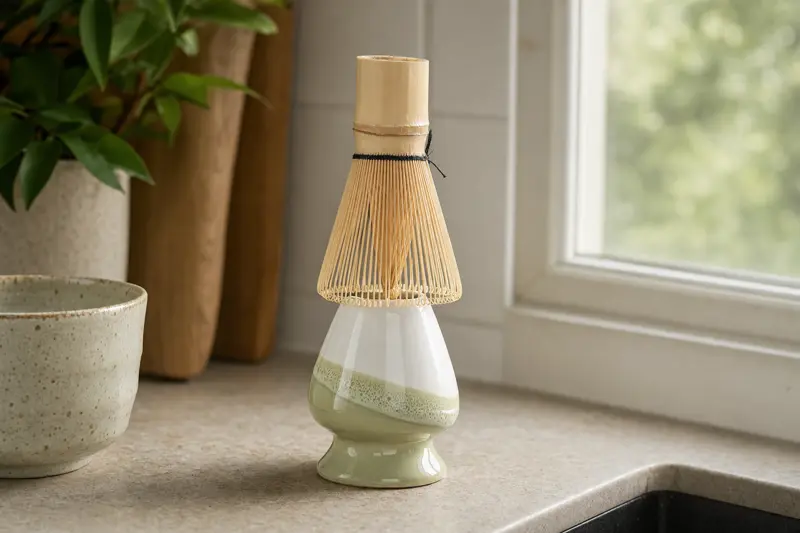
You already know the whisk needs somewhere to dry. What stalls the order is which material to put under it, because the same dome shape turns up in glazed ceramic, in turned wood or bamboo, and in molded plastic, at three very different prices.
Does the material actually change anything?
Picture the actual job. A rinsed chasen carries real water in its head, and most of it runs down the tines onto whatever is underneath, twice a day, forever. A holder is not a display stand that gets damp occasionally: it is a small object that spends its working life wet and has to be dry again by morning. If your question is the profile of the dome rather than what it is made of, that lives on our chasen holder page.
Glazed ceramic: what the fired surface gets right
Fired glaze is a sealed surface. Water beads on it and runs off, nothing soaks in, and there is no fiber for matcha to stain or for a stale smell to settle into. A rinse and a wipe returns the holder to zero, which matters when the same piece has been catching green tea water for a year. Weight helps too: at 7 by 6 cm there is enough mass to stay planted when you drop a wet whisk on it one-handed.
That same fired surface is what keeps the piece looking new. It does not scuff the way a molded dome does, so no network of scratches builds up for residue to settle into, and it does not swell or darken the way a porous holder does. At $14.95 against a list price of $24.95, you are paying for a rest that still wipes back to zero after a year of daily green tea water, with free shipping and a 30-day money-back guarantee if your counter disagrees.
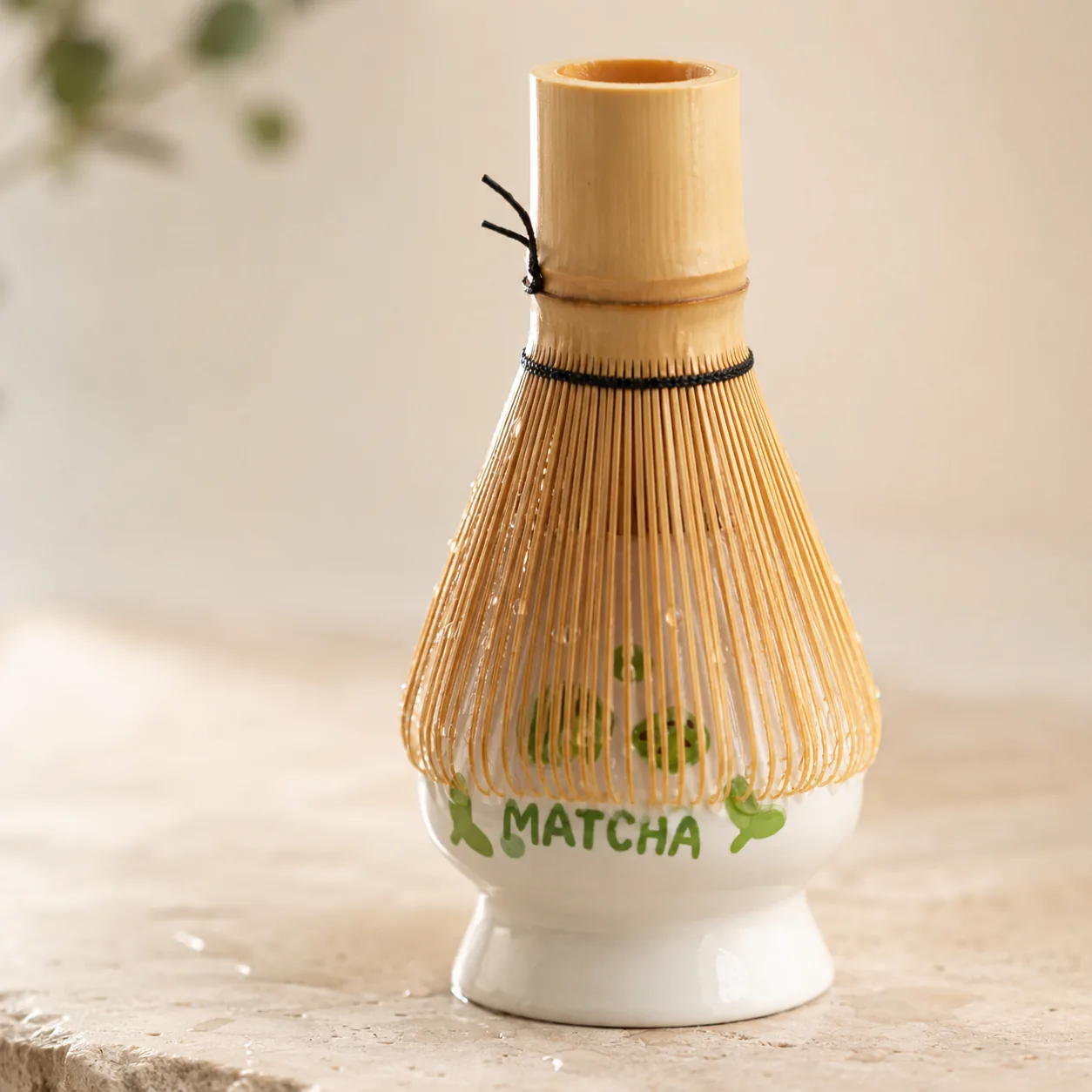
Bamboo and wood: the material of the whisk, not of the rack
Kuse naoshi have been turned in wood as well as fired in clay, and a wooden one photographs beautifully beside a bamboo chasen. The trouble starts the moment the whisk is wet, because you have then set a thirsty object on top of another thirsty object and asked only one of them to dry.
Water is where wood runs out of road. Wood and bamboo are porous, the same property that makes a chasen absorb soap, which is why our whisk cleaning guide bans detergent outright. A porous holder does not shed the water it catches, it takes some of it in, so the chasen is now draining onto a surface that has its own drying to do. Over months, matcha tints that surface and a damp fiber base is where a musty smell settles in. Bamboo has one irreplaceable job in this ritual and it is the whisk itself. Every holder in our catalog is glazed ceramic, and that is a choice: under a permanently wet whisk we want a surface that gives water back instead of keeping it.
What a plastic whisk holder does over time
A molded dome sheds water the way a fired glaze does, on the first day. What separates the two is mass and the way the surface ages, and both of those work against plastic on a counter where the whisk gets used twice a day.
Start with weight, or the lack of it: a light dome under a heavy wet whisk shifts, and a chasen that slides off its dome dries in exactly the shape you were trying to correct. Then aging: plastic scuffs, and scratched surfaces give matcha residue somewhere to settle where a wipe no longer reaches. One clarification: the clear cylinder your chasen shipped in is not a holder. It is packaging, and leaving a damp whisk inside it is the worst thing you can do to bamboo, as our storage guide explains.
The three materials, side by side
| Glazed ceramic | Bamboo or wood | Plastic | |
|---|---|---|---|
| Water on the surface | Beads and runs off | Partly absorbed, needs its own drying | Runs off |
| Cleaning | Rinse and wipe, back to zero | Wipe and air-dry, tint builds | Wipe, until the surface scuffs |
| Stability with a wet whisk | Heavy enough to stay put | Light, tips more easily | Lightest of the three |
| What shortens its life | Nothing in normal counter use | Staining and a musty smell | Scuffs and scratches |
| Under a twice-daily wet whisk | Wipes back to zero, stays planted | Takes water in, tints at the contact point | Shifts under the weight, traps residue |
What we tested, and what we did not
Our glaze check, and its limits. Before approving the holder we sell, we whisked and re-racked a chasen roughly 30 times over two weeks on sample holders in several colors, watching whether daily contact with a wet whisk wore or stained the glaze. It wiped clean every time, with no staining at the contact point. That is the column of the table we measured directly. The rest of the table describes what the surfaces themselves do with water, since porosity and scuffing are properties of the material, and they are the reason we approved a fired glaze and nothing else. Our method is on how we test.
The numbers behind this comparison
verified orders for our glazed ceramic holder, rated 4.8/5 by verified buyers
— KujiMatcha order data, 2026
the holder's footprint (2.8 × 2.4 in), enough mass to stay planted under a wet whisk
— KujiMatcha product spec sheet, 2026
of Japan's chasen production comes from Takayama, Nara, where whisks have been carved by hand for roughly 500 years
— KOGEI JAPAN traditional crafts directory, 2026
Which material belongs on your counter?
The holder spends its whole life under a wet whisk, so choose for that and nothing else. Glazed ceramic is the one surface here that gives the water straight back, carries enough mass to stay planted when you set the chasen down one-handed, and looks the same after a year of green tea. Wood asks you to dry the drying rack; plastic asks you to accept a base that moves and a surface that scratches. Whatever the material, the shape still has to be a dome: a flat peg or a mug hook holds a whisk without ever reopening the tines.
"High quality ceramic. Colors are true to photo," writes Adriana, a verified buyer in Portugal. More of them, photos included, sit on our reviews page.
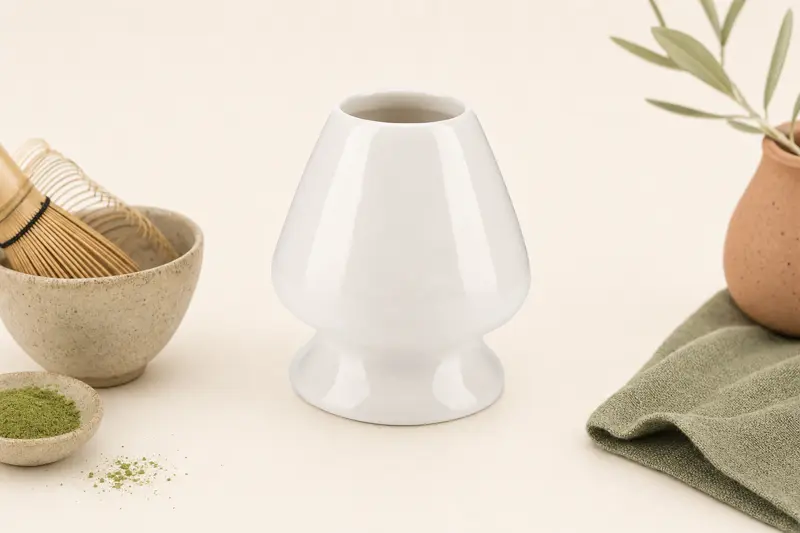
Ours is the glazed ceramic matcha whisk holder, 7 by 6 cm, ten glazes, $14.95. Building the rest of the kit? The complete 6-piece set includes a matching 7.5 cm holder alongside the bowl, chasen, sieve, and chashaku scoop. The technique side is in how to use a matcha whisk.
Material questions, answered
Is a bamboo or wooden whisk holder bad for the chasen?
It works against it. Wood is porous, so it drinks the water the chasen is there to give back, and the contact point tints over months of green tea. A fired glaze sheds that water instead.
Will a plastic whisk holder shape the tines as well as a ceramic one?
Not as reliably. A molded dome is light, so it shifts under the weight of a wet chasen and the tines settle crooked. Plastic also scuffs, and every scratch is somewhere matcha residue sits beyond the reach of a wipe.
Do you sell a wooden or bamboo whisk holder?
No, and it is deliberate. A whisk rest spends its life wet, so we want the surface under the whisk to shed water rather than absorb it.

Naomi Carter · Sourcing & Testing Lead, KujiMatcha
Naomi selects and tests every ceramic piece and whisk KujiMatcha sells on real, daily matcha preparations. She rejects more references than she approves.
You'll pick your color at the secure checkout step.